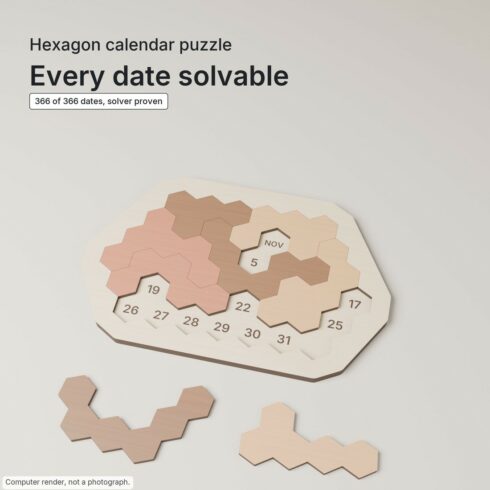
Hexagon Calendar Puzzle Laser Cut SVG
$5


| Created by | WEBZI |
|---|---|
| File type | DXF, PDF, SVG |
| File size | 6.36 MB |
| Date of Creation | November 23 2026 |
| Color | brown gray orange pink |
| Rating | 5 (9) |
| Category |
Overview
Cribbage board files for laser cutters and CNC routers, with eight layouts on one shared system. Code counted 121 holes on every track. There are three peg-hole sizes, a peg store with a locking lid, and a CNC drilling file. All of it was verified in software, not by cutting. A script ran 3,256 checks on the files with 0 failures, and the seller has not cut or photographed a finished board.
The eight layouts, an honest count of 8 designs
Each line gives the players, the board size in the 3 and 3.2 mm editions (4 mm edition in brackets) and the smallest laser bed in mm (4 mm pegs in brackets).
– CB01 Classic 2-track, 2 players, board 287 x 89 mm (321 x 89), bed 300 x 200 (400 x 300)
– CB02 Classic 3-track, 3 players, board 289 x 117 mm (324 x 117), bed 300 x 200 (400 x 300)
– CB03 4-track, 4 players or 2 teams, board 292 x 145 mm (326 x 145), bed 305 x 305 (400 x 300)
– CB04 Long board, 2 players, board 485 x 45 mm (553 x 45), bed 495 x 279 (600 x 400)
– CB05 Travel board, 2 players, board 183 x 136 mm (201 x 136), bed 300 x 200 (300 x 200)
– CB06 Oval continuous, 2 players, board 411 x 148 mm (480 x 148), bed 495 x 279 (495 x 279)
– CB07 29 board, 2 players, board 300 x 210 mm (345 x 239), bed 400 x 300 (400 x 300)
– CB08 Triangle, 3 players, board 338 x 312 mm (384 x 352), bed 600 x 400 (600 x 400)
In the 3 and 3.2 mm editions the boards run from 183 x 136 mm (travel, fits a 300 x 200 mm bed) to 485 x 45 mm (long board) and 338 x 312 mm (triangle). The 4 mm edition boards are longer, up to 553 x 45 and 384 x 352 mm. In every edition, every layout fits a 600 x 400 mm bed, and Guide.pdf lists the bed each one needs. Each layer is a separate file.
One system for every board
Inside a group of five, holes are 6.0 mm apart, and across a group gap 9.6 mm. Tracks are 7.0 mm apart, and every board uses the same five-layer stack. The 4 mm edition spaces its holes 7.0 mm apart (11.2 mm across a gap) to keep the walls between holes at 2.95 mm, so its boards are longer.
The hole count, proven
Each track has two start holes (one per peg), scoring holes 1 to 120 and its own game hole (121), which makes 123 holes per track. A script walks every track from the start holes to the game hole and checks each step, the groups of five, the street marks after 30, 60 and 90, and the skunk mark (S) between 90 and 91. All eight layouts are continuous, with one hole per point, so nobody goes round twice.
Three peg-hole sizes
– 3.05 mm holes for 3 mm pegs
– 3.25 mm holes for 1/8 in and 3.2 mm pegs
– 4.05 mm holes for 4 mm pegs
A laser beam widens a cut hole by about one kerf, so the fit can only get looser, never tighter, and no kerf editions are needed. A peg fit test strip is included. Cut it first and choose the folder that fits your pegs.
Five layers, one solid board
A base, two lower layers, a channel layer and the engraved top, all cut from one 3 mm or 1/8 in sheet. The board is 15 mm thick with every peg hole 12 mm deep (15.9 mm and 12.7 mm on 1/8 in sheet). The peg store is part of the same layers, a pocket 6 mm deep under a sliding lid of two plates, held shut by a peg in the lid’s lock hole.
In the download
– 120 laser file sets (8 layouts x 3 peg sizes x 5 layer sheets, namely top, channel, lower cut twice, base and lid) plus a peg fit test strip, so 121 file sets, each as SVG, DXF and PDF (363 files)
– 24 CNC drilling DXF files (8 layouts x 3 peg sizes) with the board profile, one drill circle per hole, and engraving lines and areas, for a solid board without the peg store
– Guide.pdf (layouts, the hole convention, assembly, peg sizes and kerf, cutting, CNC, one page per layout), the licence, a validation report and a file index with cut lengths
Technical details
– Plywood, MDF or acrylic, 3 mm or 1/8 in, with every layer from one sheet.
– Every wall around the peg store and every lid rail is 3 mm or more (rule of thumb, the sheet thickness, for parts that carry weight or take assembly force). Walls between neighbouring peg holes are a stated exception at 2.75 mm or more, drawn at 2.95 mm (3 mm edition), 2.75 mm (3.2 mm) and 2.95 mm (4 mm). The full table is in Guide.pdf.
– Layers ENGRAVE_FILL (black, numbers, labels, track symbols), ENGRAVE_LINE (green, turns, street lines) and CUT (red, inner shapes first).
– SVG at true millimetre scale, DXF R2000 with closed polylines and true arcs, PDF at 1:1.
Making a board
Cut the fit test strip and choose the peg folder. Engrave the top layer and cut every layer. Glue the layers up in order, with pegs through the corner holes to keep them aligned, and glue the two lid plates together. The files are designed for LightBurn, xTool Creative Space, Glowforge, Inkscape, Illustrator and CAM programs. They were only opened in Inkscape and read back with ezdxf, so import into those programs has not been tested.
About the images
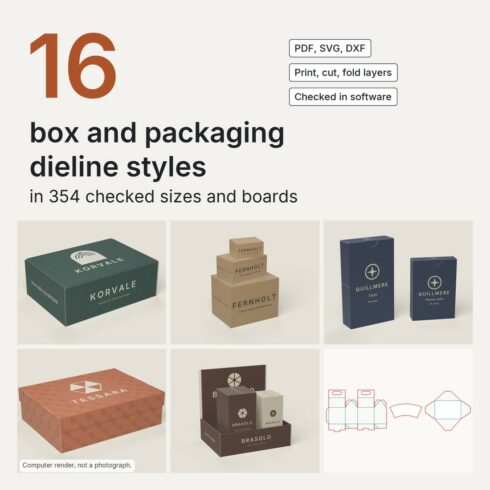
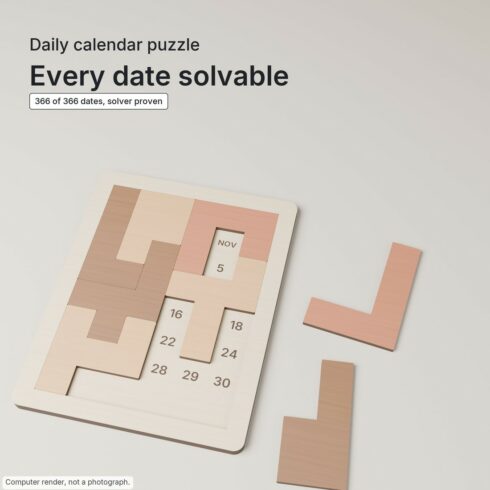
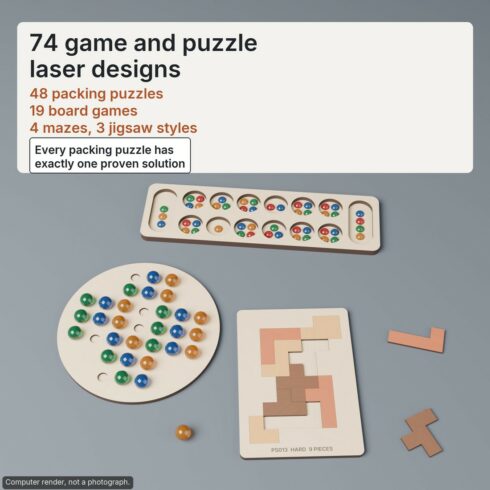
Computer renders and drawings made from the cut files. The metal pegs in the renders are not included, as pegs are not part of the download.
Download
Digital only, no physical item is sent. One ZIP with START-HERE.pdf, the files, the guide, the licence and a checksum list.
What was verified
– 121 holes per track on all 8 layouts, every step walked by code
– groups of five, street marks and skunk marks
– minimum webs, and engraving clear of every hole and edge
– every peg hole open through four layers and closed by the base
– store pocket closed and lid captured
– CNC files re-read
– laser files re-read from disk (SVG and DXF identical, sizes, areas, cut lengths, PDF page size)
– the same checks run again on the unzipped download
What was not verified
– no physical cut and no photos
– how your pegs fit
– glue-up
– import in laser or CAM software
– the short summary of how a board is used (typical, not checked against a rule book)
Licence summary
You may make and sell physical boards from the files in any quantity. You may not share, resell or redistribute the files, edited or not. The full text is in Licence.pdf. Seller: WEBZI.
How it was made
The seller designed it and produced it with their own scripts (geometry, hole-count and validation code, no image generator).